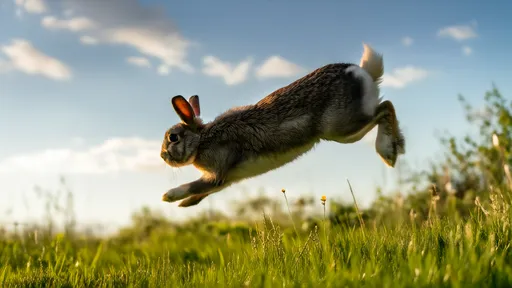
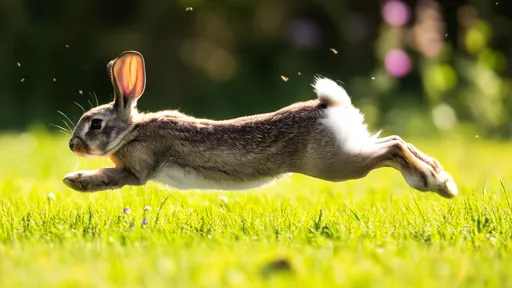
In the quiet moments of dawn or the fading light of dusk, if you are fortunate enough to witness a rabbit in its element, you may be treated to one of nature’s most delightful displays: the sudden, explosive leap known as a "binky." This isn’t merely a hop or a skip; it’s a full-bodied, acrobatic burst of motion—a twist, a kick, a mid-air jig that defies gravity and logic. To the casual observer, it might seem like a random spasm or a fit of energy, but to those who understand the language of lagomorphs, it is something far more profound: the pure, unadulterated expression of joy.
Rabbits, by their very nature, are prey animals. Their existence is often defined by caution, vigilance, and the ever-present shadow of potential danger. They are built for swift, efficient movement—powerful hind legs designed for rapid escapes, large ears tuned to the faintest whisper of threat, and eyes positioned to scan for predators from almost every angle. In such a life, moments of true safety and relaxation are rare and precious. When they occur, the response is not subtle; it is a physical eruption of contentment, a celebration of being alive and unafraid. The binky is, in essence, the embodiment of this emotional release.
The mechanics of a binky are as fascinating as the emotion behind it. It begins with a coiling of those formidable back legs, muscles tensing like springs, storing potential energy. Then, in a flash, that energy is unleashed. The rabbit launches itself upward and outward, often twisting its body mid-air, kicking its feet out with reckless abandon. Sometimes it’s a series of quick, frenetic hops; other times, it’s a single, dramatic arc accompanied by a sharp head flick. There is no practical purpose to this movement—it doesn’t help them reach food, escape danger, or communicate alarm. It is, by all accounts, a useless expenditure of energy—unless, of course, one considers the necessity of joy.
But why do they do it? What drives a creature so often associated with timidity to engage in such a vibrant, almost theatrical display? The answer lies in the complex emotional world of rabbits. Though they may seem simple, studies and observations have consistently shown that rabbits experience a range of emotions, including fear, curiosity, contentment, and yes, happiness. A binky is the physical manifestation of that happiness. It is most commonly observed in environments where the rabbit feels utterly secure: in a familiar home, a trusted human’s presence, or a protected outdoor space. It’s the lagomorph equivalent of a child spinning in a field for no reason other than the sun is shining and the world feels good.
This behavior is not limited to domestic rabbits. Wild rabbits, too, have been observed performing these joyous leaps, particularly young kits in the safety of their warren’s vicinity or after a successful forage. It serves as a reminder that even in the wild, where survival is a daily struggle, there is room for play, for exultation. The binky transcends domestication; it is a universal language of lagomorph delight.
For rabbit owners and enthusiasts, witnessing a binky is the ultimate reward. It is a clear, unmistakable sign that the animal is not merely content, but thriving. It indicates that their physical, emotional, and environmental needs are being met. A rabbit that binkies is a rabbit that feels safe, healthy, and free from stress. It is the highest compliment a rabbit can pay its caregiver—a testament to a bond built on trust and well-being.
In a broader sense, the rabbit’s binky offers a poignant lesson in emotional expression. In a world where humans often intellectualize or suppress their joys, the rabbit offers a model of pure, unfiltered exuberance. It does not overthink its happiness; it feels it, and it expresses it with its entire body. There is no self-consciousness, no moderation—just a burst of motion that says, in no uncertain terms, "I am happy to be here, right now."
So the next time you see a rabbit leap into the air for no apparent reason, remember that you are witnessing more than just a jump. You are seeing a creature, often defined by its vulnerability, embracing a moment of absolute freedom and joy. It is a dance of delight, a somatic sonnet written in the air—a reminder that happiness, in its purest form, is something to be jumped into, twisted into, and kicked out into the world with everything we have.

By /Sep 10, 2025
By /Sep 10, 2025

By /Sep 10, 2025
By /Sep 10, 2025
By /Sep 10, 2025

By /Sep 10, 2025
By /Sep 10, 2025

By /Sep 10, 2025

By /Sep 10, 2025

By /Sep 10, 2025
By /Sep 10, 2025
By /Sep 10, 2025
By /Sep 10, 2025
By /Sep 10, 2025
By /Sep 10, 2025

By /Sep 10, 2025
By /Sep 10, 2025
By /Sep 10, 2025
By /Sep 10, 2025

By /Sep 10, 2025