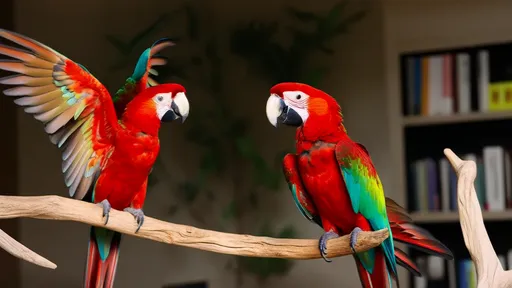
For centuries, the uncanny ability of parrots to mimic human speech has captivated and mystified us. From pirate tales to pet shops, these colorful birds have long been associated with the playful, if somewhat mindless, repetition of words and phrases. The classic image is of a bird squawking "Polly wants a cracker!" with no deeper comprehension of the request. This has led to the common perception that parrots are mere feathered recording devices, brilliantly programmed for sound but devoid of understanding. The phrase "parroting" itself has entered our lexicon as a synonym for mindless repetition. But is this centuries-old assumption actually true? A growing body of scientific research suggests we have profoundly underestimated the avian brain, forcing us to re-examine the age-old question: Do parrots truly understand what they are saying?
The journey into the parrot's mind begins with understanding the mechanics behind their mimicry. Unlike the human larynx, parrots produce sound using a syrinx, a complex organ located at the base of their trachea where the bronchi divide. This biological instrument grants them astonishing control, allowing them to replicate a vast array of sounds from the ring of a telephone to the subtle nuances of a human voice. Mimicry is a natural behavior in the wild, crucial for social bonding and integration into the flock. A parrot learns its flock's contact calls, essentially learning its native "language" to identify itself as part of the group. When a parrot is brought into a human home, we become its flock. In its effort to bond, it applies this innate talent to learning our sounds—our words, our laughs, our coughs. The initial motivation is social integration, not necessarily communication of ideas. This is where the "mindless repetition" theory finds its footing.
However, to stop there would be a grave oversimplification. The groundbreaking work of Dr. Irene Pepperberg with an African Grey parrot named Alex shattered the simplistic view of avian cognition. Alex didn't just mimic; he demonstrated a cognitive ability once thought to be the exclusive domain of primates and dolphins. Through decades of rigorous training, Alex learned to identify objects, colors, shapes, and materials. He could comprehend concepts like "same" and "different," and even express desires such as wanting to go to a different room. When shown a tray of objects, he could correctly answer questions like, "How many blue wooden blocks?" This wasn't mimicry; it was evidence of complex information processing. He used English words as true labels for concepts in his mind. His most poignant moment, now famous, came when he looked at his own reflection and asked, "What color?" Upon being told "grey" multiple times, he learned the word. From then on, he correctly identified the color grey, demonstrating not just learning but self-awareness. Alex proved that the hardware for understanding—the brain—was absolutely present.
The secret to this capacity lies in the unique structure of the parrot brain. For a long time, bird brains were dismissed as simple and primitive. Scientists now know this is a catastrophic error. While they do not have a neocortex like mammals, parrots possess a different brain structure called the pallium, which has evolved to have a similar neuron density and connectivity. Crucially, parrots have large brains for their body size, and their brains are organized in a way that facilitates complex information processing and problem-solving. These neural pathways allow for advanced cognitive functions, including memory, attention, and perhaps even a form of consciousness. This neurological hardware provides the biological foundation for not just mimicking sounds, but for attaching meaning to them. It transforms the act of speaking from a party trick into a potential tool for two-way communication.
Observations from parrot owners provide a wealth of anecdotal evidence that supports the scientific findings. Many owners report instances that strongly suggest contextual understanding. A parrot might learn to say "hello" only when someone enters the room, or "goodnight" when the lights are dimmed. Some learn to associate specific words with specific actions or objects, asking for "water" when their bowl is empty or saying "apple" when they see one. There are countless stories of parrots combining words in novel ways to describe new situations, a key indicator of linguistic comprehension. For example, upon seeing a first-time offering of a blueberry, a parrot might say "blue grape," applying known labels to a new object. This ability to generalize and innovate with language moves far beyond simple stimulus-response conditioning and hints at a genuine grasp of semantics.
Yet, it is crucial to maintain a balanced perspective. The line between comprehension and conditioned response can often be blurry. Behaviorist theory explains that a parrot can learn that saying "cracker" results in receiving a treat. This positive reinforcement strengthens the association between the word and the outcome without the bird necessarily understanding the word "cracker" as a concept for a baked good. It simply knows that producing that specific sound has a desirable effect. Much of a parrot's speech likely exists on this spectrum, a mix of true understanding and learned associations. Their intelligence is not human intelligence; it is different. They may understand the functional use of a word—"cracker" gets food—without pondering the abstract nature of hunger or baking. Attributing human-like motives and a full human understanding of language to them is a form of anthropomorphism that the science does not fully support.
So, do they understand? The answer is not a simple yes or no. It exists in a fascinating grey area. Parrots are undoubtedly capable of more than mindless repetition. The research is clear: they can learn to associate words with objects, actions, and concepts. They can use words intentionally to achieve goals, express needs, and even ask questions. They possess the neurological complexity for advanced cognitive processing. However, their understanding is likely not identical to our own. They probably do not ruminate on poetry or grasp the philosophical nuances of the words they use. Instead, they exhibit a pragmatic, functional understanding of language. They know that certain sounds, in certain contexts, create certain results and facilitate social connection. They understand that words have power.
In the end, the phenomenon of parrot speech is a profound reminder of the complexity of the animal mind. These vibrant creatures are not feathered tape recorders but sophisticated beings with a unique intelligence that allows them to bridge the communicative gap between species. They challenge our definitions of language and understanding, forcing us to expand our perspective. The next time a parrot says "Hello," it may not understand the word in the way you do, but it may very well understand that it is a sound used for greeting a member of its flock. And in that moment, a genuine, cross-species connection is made, proving that communication, in all its forms, is about far more than just the words themselves.
By /Sep 10, 2025

By /Sep 10, 2025

By /Sep 10, 2025
By /Sep 10, 2025
By /Sep 10, 2025

By /Sep 10, 2025
By /Sep 10, 2025

By /Sep 10, 2025

By /Sep 10, 2025
By /Sep 10, 2025
By /Sep 10, 2025
By /Sep 10, 2025
By /Sep 10, 2025
By /Sep 10, 2025
By /Sep 10, 2025

By /Sep 10, 2025
By /Sep 10, 2025
By /Sep 10, 2025
By /Sep 10, 2025

By /Sep 10, 2025